Gary Ling, Digital Producer, Data Monetiser, Political Savant, Information Economist, Solution Seller, Business Strategist.
"Life, is a Virtual State of Mind" - Gary Ling
  • Garys Balls
    • Ballsy Start
    • Marketing
    • Economics
    • Project Management
    • Business Strategy
    • eCommerce
    • Business Intelligence
  • Theory of Balls
    • Ling's Theory of Balls Rule 1: "Play Ball"
    • Rule 2: "Have Balls"
    • Rule 3: "Crystal Ball"
    • Rule 4: "Play The Ball"
    • Rule 5: "Talk Balls"
    • Rule 6: "Listen For Balls"
    • Rule 7: "Juggle Balls"
    • Rule 8: "Eye On The Ball"
    • Rule 9: "Score With The Ball"
    • Rule 10: "Have A Ball!"
  • Digital Thinking
    • ...Hi-Tech Cities
    • ...eCommerce
    • ...Bloomberg Reuters
    • ...User Behaviour
    • ...LoveIn My Blacky
    • ...GDS Digital By Default
    • ...InfoWorker BullsEye
    • ...The Cloud
  • DigiShorts
  • Ballsy Thinking
    • ...WikiLeaks
    • ...Stop Iranian Nukes
    • ... on UK Economy
    • ...on the EuroZone
    • ....on Terrorism
    • ...UK Independence Party
    • ...on Crime
    • ...on Social issues
    • ...on China
    • ... on Soviet Union
    • ... on Companies House
    • ... on Drones
  • Ballsy Shorts
  • Chicken Balls
  • Pit Balls
  • Maggie Balls
  • Military Balls
    • British Balls
  • Greenwich Balls
  • China Balls
  • Soviet Balls
  • Scotland Balls
  • Watford Balls
  • Adult Balls
  • Twitter Balls
  • Marketing

Lucky, happy, successful and trumped by a Humanoid in Macron's AI Temple

14/11/2018

0 Comments

 
Picture
Success and happiness in life is 60% talent, 30% perseverance and 10% luck. You can muck around with the exact percentages, but many happy and successful people rightly don’t attribute the state of their lives purely to their own talents (such recognition is also partly why they are happy and successful).
 
When it comes to technology, I’ve been ‘lucky’ all my life. I was bought up in a mainframe family as my father was an IBM engineer. I used to play with the cardboard punch cards that ran these machines. When I graduated university, I turned down fast-track jobs in banking to work with a small IT consultancy which was part of a large London accountancy firm (which became what is now Accenture). Very early on I worked on one of the first IBM PCs brought into the UK (with a 360 KB double-sided 5¼ inch floppy disk drive and a 10MB hard drive). I also encountered my first personal example of closed techno-thinking when my Dad told me over and over again that “PCs will never be able to to match the power of mainframes”.
 
Sales managers will always tell their sales people that “you make your own luck”. There is a good deal of truth to this, but “synchronicity” plays an important part in the careers of people who are seen to achieve things in business. 
 
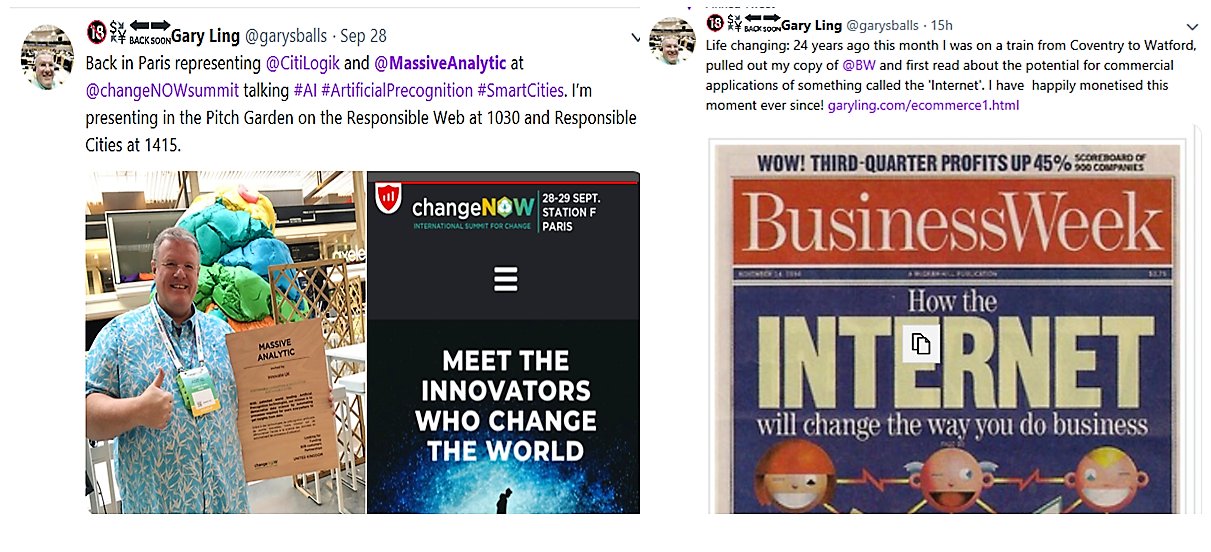
One of the most important moments of synchronicity in my life occurred 24 years ago this month when, travelling on a train from Coventry to Watford in the last week of November 1994, I pulled out my copy of BusinessWeek and first read about the potential for commercial applications of something called the 'Internet'. Given that I was working on an internal networking-type project using Lotus Notes, I immediately bought into the potential power of linking up everyone externally. It’s fair to say that I have been ‘monetising’ that moment ever since! (NB: To give Dad his due he saw how networked PCs could rival the power of mainframes).
 
Before the end of that year I was hooked up to a curated network (a pre-runner of the public, browser-driven World Wide Web) called CompuServe at 9600 baud and, the next year, launched one of the first commercial websites in the UK for Time Manager International. I saw the potential of the Internet early on and would bore people to death about how it would change the world (particularly in political campaigning). The biggest thing I learned during this period is that individuals are understandably focused on their own areas of interest and unless they stop, raise their heads and take time to think about where we are going with technology, they will lose out on opportunities for which they are very well suited.
 
Today, my digital monetisation work ensures that I am at the cutting edge of the latest technologies from where I am constantly surveying the future of humankind. This role  has never been more exciting. How we teach machines to help us with even more complex tasks is as a big a game changer as the Internet was mooted to be on my train ride back then. It might be a misnomer to call many of these current applications ‘Artificial Intelligence’ (since this relates to comparing machines to humans) but in a very short time these machine learning applications will make a real difference to our everyday lives (they are only scratching the surface right now).
 
One area in which I have recently worked with clients on investment proposals is around AI models for precision medicine. This is an “emerging approach for disease treatment and prevention that considers individual variability in genes, environment, and lifestyle for each person." The gains for humankind of the advanced mathematics being deployed to understand the relationships of data points in this area are incredible. So much so that at an AI event at President Macron’s Temple to AI, Station F, in Paris in September I was touting a version of the future where, in 25 years’ time, patients will go to see their local GP, sit in a chair where they will poop, wee, have their finger pricked for blood, spit in a receptacle and within a few short minutes exit through one of two doors. Behind Door 1 will be a cup of tea and computer screen telling them that they’re fine. Behind Door 2 will be a specially trained, empathetic, counsellor who will explain just how screwed they are.   
 
I incorporated this story into my pitch back at the exhibition stand financed by Innovate UK, the UK’s Innovation agency, where I was representing two of the most exciting UK SMEs in the AI, Big Data space, Citi Logik and Massive Analytic. Having confidently made my prognostication, my vision was trumped by a smart, young, French Data Science student who was a part of an attentive crowd. “I don’t think that is right,” he offered. “When I am your age, that empathic representative behind Door 2 will be a computer – a humanoid.” 

Wow, OK! I can argue about the timeframe but now have a gallic-induced expanded vision. I just hope that I'm around for that (and still visiting Paris!).
0 Comments

Don't put all your digital eggs in the basket of just one Tech Titan

7/9/2017

0 Comments

 
Picture
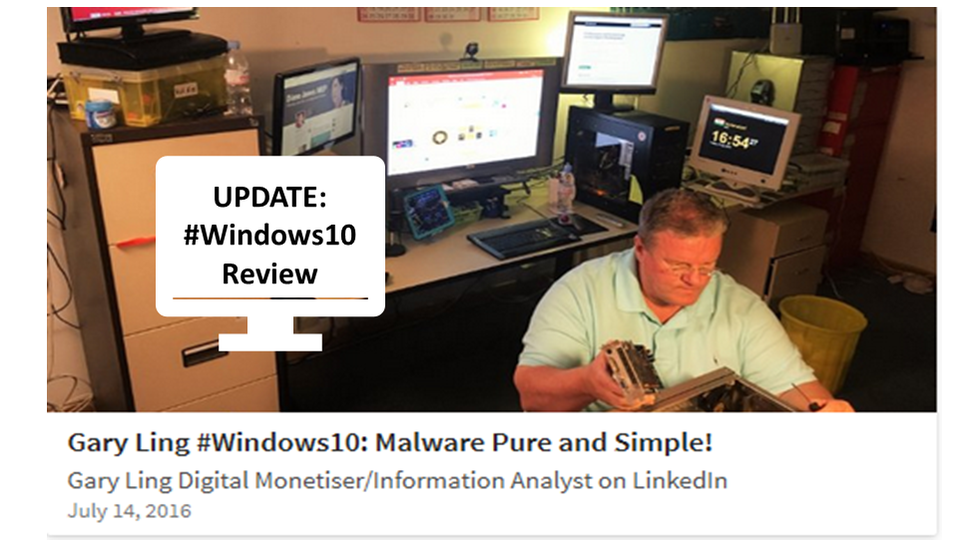
Gary revisits his July 2016 review of Microsoft's Windows10 where he found evidence of marketing malpractice
My July 2016 post entitled “Windows10: Malware Pure and Simple” was an article about how an arrogant Global Tech Titan uses its powerful position to abuse its customer base. The piece was the second most read of my articles on LinkedIn and on my website last year (the first was “If Watford #Brexits, Britain Exits”). A few weeks ago, a colleague said she had read it and was wary of upgrading from Windows 7 Professional. Considering this, I thought I would update where I am now with Windows10 and emphasise the message that individuals should never put all their digital eggs in the basket of just one Tech Titan, no matter how good the offer sounds.

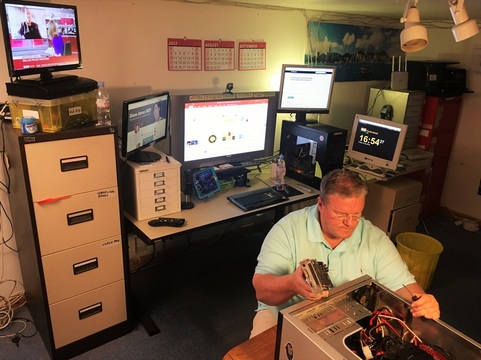
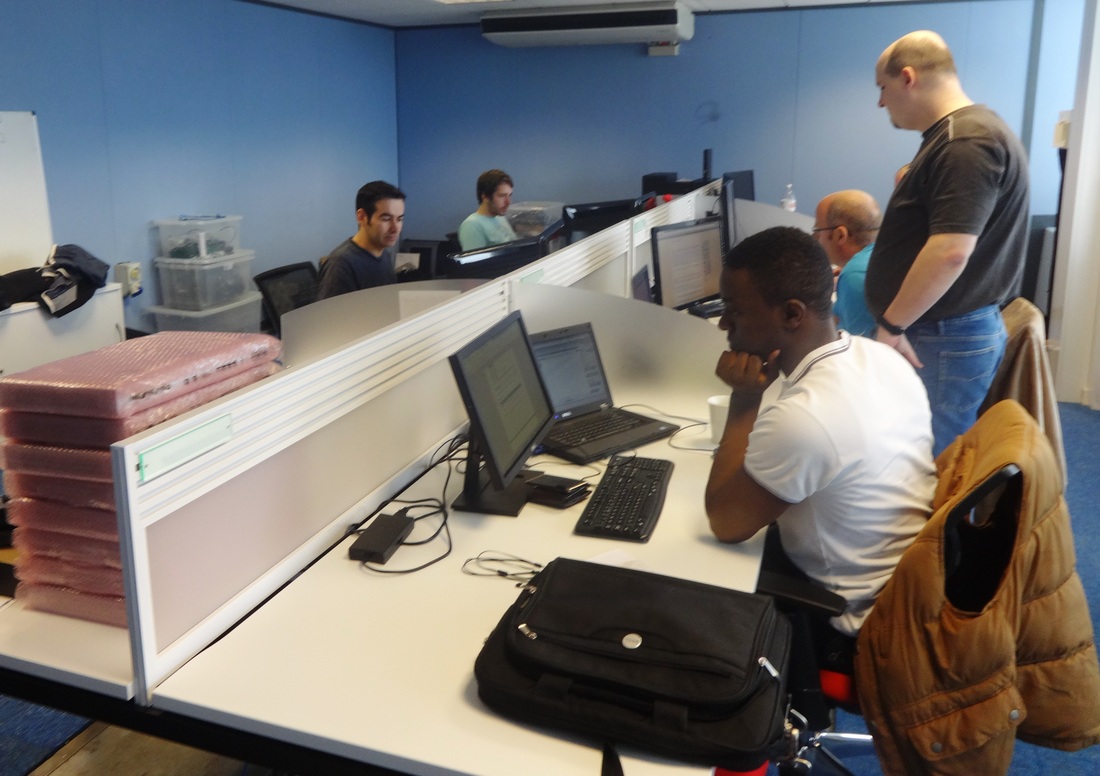
Shortly after I posted last year, Microsoft pumped out its major ‘Anniversary Update’ (Version 1607) for Windows10 which (over time with subsequent minor updates) sorted out a lot of the issues I referred to back then. I now find Windows10 to be remarkably stable as a desktop operating system. However, because of its early troubles, I ditched my Microsoft tablets and relegated my Lenovo Twist laptop (which runs better on the updated Win10) and today only really use Windows10 to power a multiscreen desktop PC setup in the office (see photo). 

As I mentioned in the article I was also thinking about moving to the Apple operating system and have done this by purchasing a MacBook - although this was not entirely as a result of the Windows10 launch debacle. Anyone who works in today’s tech environment can see that MAC portables/tablets have stolen a huge share of the Developer and Millennials segments, together with Apple’s traditional Designer/New Media fraternity. I incorporated the MAC into my stable of tech tools because I felt I just had to keep up! So now I travel with and within the Apple ecosystem with the iPhone (still miss my Blackberry), iPad and MacBook.

As a result, I have come to appreciate the advantages that a company flogging an operating system has if it can fully control, and integrate with, its manufactured hardware as well. It makes perfect sense for Microsoft to put a huge investment into its Surface range. Even though I judge Windows to be a better operating system than Apple's now, the Apple OS integration with the small form factor of a MacBook leads the ultra-notebook category.

All of which does not let Microsoft off the hook for dumping a sub-standard (not even sub-optimal) Windows10 into the market two years ago and counting on people like me to fix it on the fly before Version 1607. Microsoft’s record in introducing its operating systems into mobile devices (think phones) is not good and if they try this crappy practice in rolling out their new own brand manufactured ultra-portables/tablet desktop replacement range in the future, they will likely fail in a way which makes it impossible for them to recover. Microsoft’s growth is coming from Cloud services. It doesn’t take much to lose you name in this market given the levels of competition.

My advice in response to my colleague was go ahead, upgrade to Windows10. But try Google’s Cloud office suite so you don’t put all your eggs in one Tech Titan’s pocket. Microsoft's Windows10 launch practices were the arrogance of one such Titan and I have learned my lesson. I even use Google Docs on my MacBook as it has recently settled in nicely into the MAC world an am loyal to DropBox for storage, although for how long it can stay ‘independent’ remains to be seen. Using the digital services of just one supplier whether it be a telco's quadruple play (phone, TV, broadband, mobile) or the company that supples your hardware and operating system (Apple iTunes, TV, Music etc) is just a really dumb idea. No one company can innovate in all the areas that matter to your digital life. The more areas that you hand over to them to service, the more dependent you are on one supplier, and the more arrogant they get.
0 Comments

How can governments help national businesses reinvent light bulbs?

5/9/2017

0 Comments

 
Almost unnoticed the UK has become a world leader in nurturing government backed innovation. It is helping many industries to reinvent their own versions of the light bulb. I have recently been involved in helping clients who seek to raise money with pitches to venture capital organisations or with submissions in response to Innovate UK funding calls. Most people are aware of what VCs purport to do in our economy but many may be unaware of ‘Innovate UK’. It holds itself out to be the “UK's innovation agency” and is an executive non-departmental public body, sponsored by the Department for Business, Energy & Industrial Strategy (BEIS). It is an organisation of around 300 staff and since 2007 says it has committed over £1.8 billion to innovation, matched by a similar amount in partner and business funding.
​
I first submitted bids for UK government innovation money when Innovate UK was called the ‘Technology Strategy Board’ and, as an ardent free marketer, was sceptical of how effective government can be in ‘picking winners’ on the industrial landscape. However, as years have passed I have come to realise that, in practice, Innovate UK has proven its worth as a part of Britain’s sophisticated digital economy. This is not to say that I am convinced that the Prime Minister’s latest push for a much more comprehensive ‘industrial strategy’ is either desirable in Global Britain or has much chance of being effective given our short political time frames (think NHS reforms) – but this is a matter for another blog post.

Having given this some serious thought over past year since the UK's EU Referendum, I now see Innovate UK having three core strengths that can boost Britain’s economy in a post-Brexit world:  

First the UK's Innovation Agency, is very good at identifying broad ‘future problem areas’ which will need innovative solutions. Post the 2007/8 Great Global Financial Correction, most government’s around the world must make do with getting more from less in trying to solve some of the greatest problems facing their citizens. These may be health issues associated with aging populations or issues surrounding the quality of life in urban environments as more people move into cities. A look at the Innovate UK website shows that they have a good understanding of where future problems are likely to crop up or, more importantly, get worse.

Second, Calls for bids for Innovate UK funds show that they understand that “the trend is your friend.” They appear to be staffed with knowledgeable people who are tapped into the latest cutting edge thinking which is driving momentum in a whole range of areas from biomedical, digital health to connected autonomous vehicles, innovation in rail, connected transport and emerging and enabling technologies. In some cases, Innovate UK money may be awarded to ‘bleeding edge’ technology within an emerging trend that would never get funding from elsewhere, like those in its First of a Kind competitions.

Third, Innovate UK has developed world class processes for both awarding and tracking the success of taxpayers’ money spent on innovation. From whether such leading-edge technology solutions  pass the informed ‘Sniff Test’ (which is all you may have to go on in the most bloody of bleeding edge innovations)  to a robust but flexible analysis of how the money is spent, Innovate UK leads the world, surpassing in many instances even the accountability benchmark procedures of Britain’s VC companies.  

Today, it is not surprising that other countries which are trying to understand how to finance their own national innovation schemes are looking to Britain as source of best practice in this area. As a result, Innovate UK are sending some of their brightest across the globe to set up Innovate UK-type Calls in which British firms can link up with partners in distant markets (India, China). Clearly, as Britain Brexits (and the EU’s share of the world economy falls to only 13% without us) the Government hopes that Britain’s entrepreneurs will open their eyes to the opportunities in these markets.

Whether it is possible to set up an Innovate UK style body in countries with higher levels of corruption than in the UK is open to question. Robust integrity in awarding public money may turn out to be the most significant prerequisite for any state to successfully seed fund national businesses who have the best ideas to solve future problems. In this case, these less scrupulous countries can let the UK innovate these ideas and then steal them as they have done in the past.
0 Comments

#Windows10: Malware Pure and Simple!

15/7/2016

0 Comments

 
Picture
It takes a lot for me to turn away from my command centre office desk shown in the photo above but cries of help from close associates will normally do it. As I am known in my social network for being someone who builds his own PCs, I have been inundated by requests from people since its launch last summer for help with Windows 10 and have gone through several upgrades and new installs. I have even bought a Microsoft built machine with native Windows 10 and experienced problems with the operating system right out the box.

On 25 December 2015 I purchased a Microsoft Surface tablet/PC in the Amazon Christmas sales. Just a few months later on 15 March it went missing at Atlanta airport partly I’m sure down to my own stupidity and carelessness. Whilst I have been kicking myself for the last few months about this I have also been wondering how I have never lost any of my iPads, Android Phablets, Blackberry’s or iPhones for the past 6 years and yet I offered this machine much less protection in its short time with me on my travels. I have come to the conclusion that the reason is that Windows 10 is malware, pure and simple and while I am not psychologist it is clear the upgrade or new install processes for Windows 10 are doing my head in. I drove that tiny tablet out of my life! I now recognise that I have a subconscious aversion to Microsoft Windows 10 which one of the world largest corporations has let loose on an unsuspecting global user base way before they should have. 

This short note gives five tips for PC users to avoid my mental state as Microsoft gradually withdraws support from earlier Windows versions and stops the free Windows 7 to Windows 10 upgrade offer on 31 July, so making Windows 10 eventually unavoidable.


Tip 1:  Don’t accept automatic upgrades to Windows 10 without reading the four other tips below.  A month ago my 85 year-old mum was force fed a Windows 10 upgrade which mean that I had to scurry round there and spend a few hours sorting out her desktop.  It is so confusing for her now that I have said that she must do all her Silver Surfing from her favourite chair with a new iPad Air (but please, please remember to close all those Safari Windows Mum, you must have the record for opening new ones!)

Tip 2: Remember the pre-install Windows 10 ‘Compatibility Check’ is as about as much use as balls on a mosquito!
It seems only to check disk space and memory. It has never been able to comprehensively assess whether the peripherals/drivers on any machine that I have upgraded are suitable for Windows 10 – particularly if you are upgrading from Windows 7 or have multiple monitors/more than one graphics card onboard. (Check out me having to take out a graphics card above before a Windows 10 upgrade will start up after an install from Windows 7. I tell you I want to stick that card somewhere up or on a Microsoft director!). In short if you are upgrading from legacy windows expect to be frustrated until you can plough through issues. This is particularly true if you have a notebook with lots of pesky OEM bloat software (Lenovo has to be the worst!) which itself has to be upgraded or amended to adapt to Windows 10.


Tip 3: Be wary of Microsoft support blogs which say you should hack the Windows registry as a solution.
Seriously, I lost a cursor (it just vanished from the screen) on one Windows 8 to 10 laptop upgrade late last year and actually found this as a prescribed solution on a blog whilst working out of the Premier Inn in Chester. The hack worked but proves that this software was not ready for a mass audience. Microsoft say Windows 10 is FREE. I should bill the blighters for all the time I have spent fixing it.  I have not found the missing cursor bug in any of the installs I have done in 2016 so...Instead of upgrading just before you head off for a road trip and have to do things like registry hacks follow tip 4….


Tip 4: One of the issues with Windows 10 is you never know which version of the operating system you are downloading or have bought (particularly on eBay) and what issues have been updated and fixed unless you plough through detailed release notes and become a Windows 10 Aficionado.
  Plan a few days when you don’t have to use your updated PC for drop dead tasks and let the software settle down.  Turn the device or PC on for 3 hours at a time, use gently and then restart and let the automatic updates take effect. You may waste your time trying to fix one issue that you have found early on only to find that it would be fixed by the next update.


Tip 5: Beware the war for your eyeballs and patronage.
Microsoft have been losing the browser wars and are using Windows 10 (and their Edge ‘browser’ in particular) to try to ram their way to the top.  If you are a Google Chrome user like me, you will find this very irritating. Even on the latest install of Windows 10 I’ve done (a month ago) driving those multiple screens behind me in the photo above, Chrome is unstable.  It is obvious that Microsoft are out to stuff Alphabet (Google) and people (like you and me) are collateral damage.  


I said 5 tips, I would add another more personal one: if you find problems with Windows 10 - Don’t call me unless you are prepared to pay for a Therapist!


Follow Gary on Twitter @GarysBalls

0 Comments

Take brilliant #Revolut on a post #EURef Holiday to manage your FX

27/6/2016

0 Comments

 
Foreign exchange (FX) management issues are always part of any international travel plans. So far this year my travels have taken me to eight countries (nine if you include Scotland, which for peace at home purposes, I most definitely do!).  I am always on the lookout for the latest ways to: 1) reduce FX fees; 2) Keep things digital; and 3) most importantly, make FX convenient. Money needs to grease the wheels of any travel experience whether it’s for business or pleasure, not be a worry or a hassle.

In constantly scanning for the latest in FinTech to help with this I stumbled across a great App for your smartphone that I highly recommend you sign up to in order to manage your FX requirements – it’s called REVOLUT. Digital Sign Up is simple if you have a bank account. You can even do the identification check online by sending through an in-App photo of your driving license or passport.

I was impressed by how much this small London-based technology start-up is an upgrade on what’s currently on the pre-paid FX card market. In short, the App is linked to a pre-paid MasterCard. It lets you load money from your domestic bank account and then spend in over 90 currencies around the world at the spot rate, the best exchange rate available with no fees. To be able to do this for secondary currencies other than USD, Euro and sterling is fantastic. I can attest it works too, when I exchanged sterling for Croatian Kuna's on a recent visit.

Picture
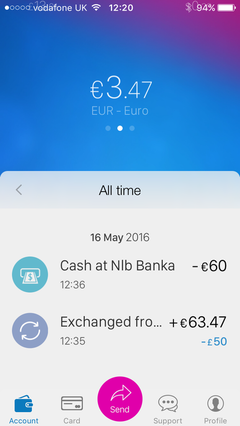
Money transfer is incredibly fast and if you order a real world Revolut credit card you can manage your FX to the minute and avoid bringing back cash that you have to change back into sterling. Recently on a short visit to Montenegro for example I sat at a coffee shop opposite an ATM machine, realized I was running short of Euros. I exchanged £50 through Revolut on the fly at the Spot Euro rate (that is the real time market rate for the currency pair) at 1235hrs, walked across the street, stuck my Revolut card in the ATM and withdrew €50 at 1236hrs! 

Even more amazing, was that the transaction immediately appeared in my account and the detail could be viewed on my phone (Revolut supports both Android and iOS).

The web tells me that Revolut is raising £10 million and signing up 1,500 new customers a day... I can understand why!

It's a step up even on the product offerings of the FinTech in FX pre-paid which have gone before. 
Picture
0 Comments

The Great London Tech Census Pap!

31/10/2014

0 Comments

 
Picture
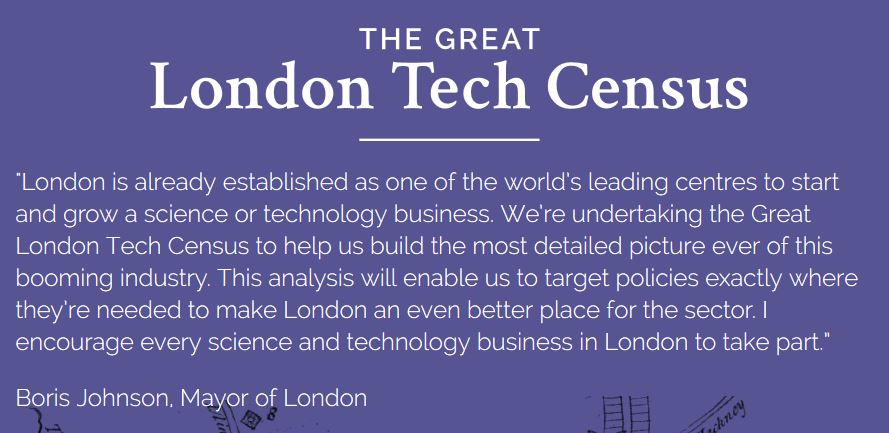
The Greater London Authority (GLA) launches yet another digital initiative. This time it's the 'Great London Tech Census'. So together with the Coalition's Superconnected Cities scheme and London's UK Tech City intiatives, Mayor Boris now wants to get a 'detailed picture' of this 'booming industry'. 

What a lot of pap! I really do hope that not too much public money is being wasted on this. Aims such as to help policymakers through social media analysis so: "they can highlight which areas in the world are talking the most about London tech and therefore help organisations like Tech City UK focus their attention" are absolute bunkum. Organisations like Tech City UK should already know where  the tech clusters are in London since they have had enough public money and Google help to do so. In fact, the Tech City UK organisation in its present form is turning out to be a colossal waste of public money. As we run up to the general election, it's turning into the Conservative Party's poodle!

‘Tech City movements' need to be locally focused (at, say, borough level) since all 32 London boroughs are different. The volunteer driven Croydon Tech City group is a good example of how this should work.

And pray tell, what aspects of this Great London Tech Census make it a 'big data' project? A few crappy data points from Companies House data that are probably out of date or irrelevant to what the organisers are trying to achieve since so many companies file serviced office addresses and abbreviated accounts. And what Internet Entrepreneur in their right mind will volunteer commercially confidential data to a project which has as its underlying principle: "Hi, we're from the Government and we're here to help!”?

If it really wants to add value, government elected representatives and officials at all levels (but particularly at the level closest to the communities from which businesses grow) should be helping tech companies to PRACTICALLY be able to SCALE their propositions and OPERATIONALISE the innovative ideas that so many of our young people come up with but can’t turn from vision to reality!


See here article which gives policymakers a good place to start...
0 Comments

Natterbox – On Top of the World with a Fast CVS Internet Connection

5/8/2014

0 Comments

 
Picture‘Natterboxers’ look down on all they survey in south London and even have line of sight with Canary Wharf (circled). Surely this is a great place to shake up Croydon’s business broadband market by attaching a Fixed Wireless Antennae? The Borough’s potential CVS customers’ are there for the taking – all that’s missing is entrepreneurial spirit!
Contact Gary to learn how he can write marketing copy for your business: Tel +44 7878 372 158 or Email: [email protected]

On assignment for the Croydon Council Economic Development Team, Gary Ling, visits a local business making the most of the government's Connection Voucher Scheme.

Natterbox Connection Stats: 
Supplier: Switch IP 
Type: 100MB/1GB Leased Line 
Installation cost to server room: £3000 (plus VAT) 
Length of Contract: 3 Years Monthly Cost: £450 (plus VAT) 

Some ambitious worldwide tech companies try to retain and recruit their talent by offering free organic grub and skateboards to aid their mobility around a vast campus. Others offer their critical people a personal masseuse and the services of a professional snipper, who trims that all important Bonsai tree, which reminds the unworldly that not all that is beautiful on this earth emanates from a fat pipe fast internet connection. Yet at up and coming, Croydon based, independent global telecoms company Natterbox Limited, it’s got to be the spectacular, panoramic view that clinches it!


As one of Croydon’s latest participants in the Connection Voucher Scheme (CVS) I visit Natterbox just as it is moving into the Borough and as with all well managed firms the directors have made the most of it. While the CVS aims to award vouchers to small and medium sized businesses, charities, social enterprises and other not-for-profit  enterprises to assist them to upgrade their Internet connections to Hi-Grade broadband, it is only one of the schemes that Croydon uses to attract businesses. As well as taking advantage of the CVS, Natterbox had matching funding for some capital costs and a year free of business rates. With Croydon’s great transportation connections, a good supply of IT talent and a supportive buzz about the digital economy, Natterbox are off to a great start in the world’s first Tech Borough!

I am met in reception by Natterbox’s Chief Operating Officer (COO), Adrian Evans on the 11th floor, which is a temporary slot for the company before they move up to take over the top floors at 23 and 24. Adrian seems surprisingly relaxed for a man overseeing a £400,000 redesign of the new offices as well as making sure Natterbox’s customers are happy with their current services. He is wearing a t-shirt which shows a chest full of binary code. Since this is part of the logo for my business, I immediately assume he is a kindred spirit and it turns out I am not wrong. Adrian is full of energy and as a former ICT secondary school teacher has very specific ideas of the type of culture that Natterbox is cultivating for the assembled crew at their prestigious setup at No.1 Croydon, an address known locally as the ‘50p building’ because of its peculiar shape.

Picture
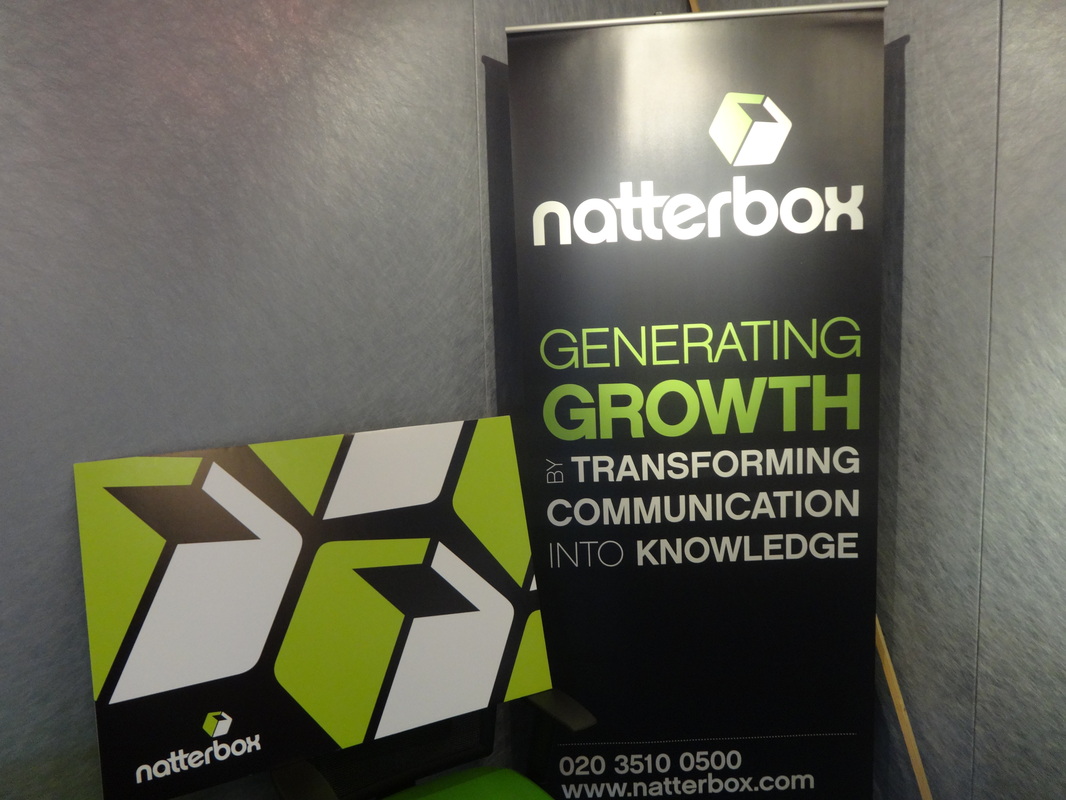
Natterbox’s temporary reception belies the attention to detail and design that the company is putting into its new offices. This is a company that understands that a fast internet connection is a necessary but not a sufficient condition for ‘transforming communication into knowledge’.
It is noticeable, that even this temporary Natterbox office is filled with a frenetic urgency fuelled by the new people who are joining every month and where everybody is still finding out where everything is. This is not surprising as the company was started by three people in a room above a hairdresser in Oxted and has achieved its own growth trajectory. Adrian explains, “Out growing our Oxted premises meant that we had to find a southern UK base with easy transport connections and good catchment area for staffing, where we could put down some roots for expansion so that we would not have to move to another area in just a few years. We looked as far south as Brighton and assessed other London locations but Croydon in the end was an easy choice. It ticked all the boxes and with the new Croydon Retail Partnership development it is clear that there is a new energy about the place.”

Since I am known for stating the ‘bleeding obvious’ and subscribe to the view that the only stupid question is the one you don’t ask, I quiz the COO of this telecoms software house about how important fast internet is to his business. I am grateful for Adrian’s forbearance when he brings me up to date with the market that Natterbox serves: “There are very few industries which are not being transformed by digital technologies today – particularly in the B2B space where we are. We have a wide range of customers from Groupon, which of course didn’t even exist a few years ago but is now a marketing powerhouse, to publishing giant Trinity Mirror in the UK which is morphing its traditional publishing model to a digital one, and some of the world’s most important Tier 1 financial institutions, such as global banks, where geographic routing and recording of calls for compliance purposes is really important.
PictureNatterbox’s COO Adrian Evans wants people who can think, working on the top floors of the 50p building. Being high up and having a fast CVS connection to the Internet backbone is at the heart of it. The whole ‘feel’ of the place screams: ‘You’re here to step up and make a difference!’


“All of our services demand some form of data connection. Our VOIP product can work on as little as a 2MB connection where the VOIP takes priority over PC data requests through a proper traffic sharing regime. Our proprietary software profiles a call and routes it intelligently to the appropriate person or team. But recording all voice communication for compliance via our special SIM cards is storage intensive and moving around large chucks of data demands a bigger pipe.”

So is all this data is stored in the 50p Building and is this why the CVS connection is so vital? “We only have a few in-house servers here for our developers to play with and all that data is backed up off site,” Adrian responds. “Otherwise, all our data is managed in data centres around the world. In addition to the Croydon UK office we have a presence in the US and Asia since this is where our clients operate and where we turn their information into data points that they can use as a part of their CRM (customer relationship management) activities. Operational guys on this floor support all our international services as required. The accounts team use cloud based services such as Salesforce.com to power their sales effort. The finance guys use SAGE in the cloud to organise our financials and the customer services team use Mindtouch in the cloud to improve customer support and workflow. From these activities alone you can see why, with the added incentive of the CVS voucher, putting in a very fast connection is a real value add to our business.”

Before long, we are whisked in a dedicated express elevator up to the top floors where Natterbox’s new operations centre is under construction. As we exit, I am slightly lightheaded and recall a time a decade ago helping my American mate, Joe, ‘pull wire’ as he built digital homes in Florida. I can almost feel the leather tool belt around my waist and imagine that I looked like one of those bare chested blokes from the Village People (minus the rich, oily tan, flat stomach and the highly developed pecs). Then, as I regain my equilibrium, the true memory of that time returns and that is that Joe was always screaming at me to not ‘over pull’ the Cat 5 as it ‘degrades its conductivity’.

Picture
Filled to the brim with the latest hardware and technology, Natterboxers know that unless it’s all connected up their kit adds about as much value as a garden gnome!
Today, high speed Internet is carried over distances in buildings like the 50p by Cat 6 (or Gigabit Ethernet) cable and I ask Adrian who is pulling wire to the 23rd floor. “We are fortunate that our supplier is Switch Communications who also inhabit this building so have a superb infrastructure to build off,” he says. “In fact it was Switch who recommended the CVS to us and also put in the Cat 6 to these floors.”

It’s also fortunate for Natterbox that the connection voucher of up to £3,000 awarded under the CVS can be used to cover the pulled wire cost to a recipient’s business premises because it’s a heck of a long way from the street to the 23 floor of the 50p building!

As I return to earth, the warm, positive vibe from my Natterbox visit leaves me with a spring in my step. It’s great that a UK business can be started from a room over a hairdresser in Oxted and start to employ such good people. It really looks like this business will scale which is an essential ingredient for success. It’s great that central and local governments have been supportive of this sort of business which is essential for the UK’s economic future. I decide that I must maintain this positive momentum with some friendly natter, pull out my smartphone and VOIP Joe in sunny Florida: “Hey mate, any chance that leather tool belt is still available…”
0 Comments

Serving Up the Five Forces of the UK Digital Policy Pentagon

6/6/2014

0 Comments

 
PictureEvery UK policymaker concerned with the digital economy should service this Pentagon!
Today I speak in an afternoon panel debate entitled 'Investment and Policy Options' at the Tech City 2014 conference. When I was originally sent the proposed agenda a few months ago the session was simply labelled 'Investment'. Since one of my other incarnations is to consult with an investment committee for a small (£300m) investment fund (see the recommendations on my LinkedIn page) and consequently attend a lot of informative, big institutional, events in The City listening about 'investments' I pushed back to the organisers and suggested that they add the 'Policy Options' bit. Fortunately, they agreed and I present something here which simply encapsulates my current thinking on UK digital policy.

Over the past couple of years I have been fortunate enough to have worked on projects related to the Government's Digital By Default initiative - see HERE - and also witnessed the effects of Broadband Delivery UK's (BDUK) £100m Connection Voucher Scheme (CVS) - See HERE. Putting these experiences together with those I have as an Internet entrepreneur results in this "Policy Pentagon – The Five Forces That Create a Successful ‘Tech City’". As denoted in the centre of the pentagon, the target of UK digital policy should be to: promote jobs, enterprise growth and economic prosperity. Successfully harnessing the forces operating in these five areas will deliver these things. Here is a brief outline of my presentation notes and my assessed scores out of 10 for how well the UK is doing right now in national policy terms:

Force No 1: Digital is a 'Hygiene' Factor
This event is called the ‘Tech City Summit 2014’. But all too often high profile policies on ‘Tech Cities’ substitute for UK Digital Policy. It’s almost as if the sexy bits of digital, i.e. the (very few) young people who make their millions from digital start-ups, are proffered as a sign post for the UK’s digital success. In fact, practically all aspects of the UK economy will be impacted by digital technologies. Over the next decade hi-speed broadband connections will be as essential for business success in all sectors of our economy as having a safe place to work. Two mega trends are the reason for this: The Internet of Things – where more and more inanimate objects are reporting back to the Cloud on how well they are performing the task that humans have set for them; and, the ‘sharing’ or ‘collaborative’ economy, where digital connections make it easy to share the value of human and physical assets. Money Week Editor, Merryn Somerset Webb, writing in the FT (26/4/14) estimates the value of the ‘sharing economy’ to UK consumers in 2013 at £4.6B through the use of such sites as Parkatmyhouse, mondaytofriday, zopa, Uber and Airbnb (the latest fundraising rounds for the last two valued the web properties at $18.5B and $10B respectively).

Score 7/10: Digital By Default is the government’s transformation of public facing transactional systems. The Coalition has rightly recognised hi-speed Internet as an economic priority for Britain. But the structure of the broadband market with a powerful BT at its Open Reach centre is bad for Britain and is slowing the roll out of fast internet to business.

Force No 2: VC Money Backs People and Propositions
In the digital space, venture capital money backs people and propositions (rather than mere technology) who ride the latest digital themes. Right now these are: mobile, location, social, health and productivity. In many cases technological advantages are short term and ephemeral. Whereas the combination of a good proposition and competent people can pivot towards success as they roll out their business and face the reality of market forces where rubber hits the road.

Score 8/10: The UK is blessed with great financing options for all types and sizes of business from traditional bank support (yes it's still out there), VC and crowd funding to an AIM listing and City restructuring. Several government schemes are also good for start-ups. But the Technology Strategy Board still backs technology-led bids with its millions in government funding. This is sub-optimal and must change.

Force No 3: Policy Accentuates Scale and Managing on the Margin
One of the most important lessons of business management is that success is a result of making good marginal decisions. (see also: “It’s the NUMBER of decisions Stupid!” HERE). These are the everyday judgement decisions that from an analytical point of view are not clear cut – they could go either way. Often they deal with boosting relationships and cash flow. Together with a business’ ability to scale getting more of these decisions right is a recipe for great success. A national digital policy that helps support its business people with coaching, mentoring and training in these areas will reap big rewards.

Score 5/10: This is an under-appreciated aspect of UK national digital policy and the government has it only half right. Too much emphasis is placed on finance and 'hard' factors like office space rather than the softer but critical support aspects of growing a business. Some of the major tech firms in world started in their founder's garages. At the critical time when they were formulating their initial propositions they didn't need an 'office' - they needed any space where they could think and collaborate. The number of companies newly registered at Companies House may well be at record levels but the percentage of these that register for VAT is lamentably small which indicates turnovers don't meet the VAT threshold and are either dormant or one person operations. To reach an enterprise growth tipping point, UK start-ups must scale.

Force No 4: Avoids Form over Substance
By its very nature crafting a UK digital policy is a political process. Vested interests have to be assuaged and coalitions formed. Yet this should not mean that form triumphs over substance. Neither, because the digital universe tends to be governed by short form communication (140 characters the norm?), does good public relations act as a substitute for well thoughtout policy. The Labour Party's decision to support London Black cabs against the sharing economy Uber App is a case in point. Suppose this world changing Internet start-up was started in Britain as a result of UK digital policy. Would the Labour Party still feel the same way? One of the best ways that digital policy can help start-ups scale is to offer them operational gateways to resources that can achieve this. Linking up with low cost 'coding locations' in other countries (Hyderabad? Belarus?) can help UK start-ups follow well-trodden paths to turn their intentions into reality.

[NB: At present, England's schools lag in the teaching of maths thought to be an essential basis for good coding but rank highly for international 'problem solving'. The Indian state of Andhra Pradesh (now with Telegana) produces 250,000 engineers coder graduates a year! Has the UK lost its international competitive advantage in this area?  The UK often leads the way in coming up with creative solutions and ideas which other countries capitalise on commercially. UK Digital Policy should not allow our Internet entrepreneurs to fall into the same trap.]

Score 5/10: Current digital policy for start ups is focused too much on the ‘Tech City’ concept in east London. The whole of Britain needs to be included in national policy if we are not to perpetuate the north-south divide.

Force No 5: Localism is the Political Currency
Even if any future government is to extend the Tech City concept nationally, geography matters since global capital follows local policy. The number of multinational companies returning to UK shores as a result of corporate tax changes evidences this. In formulating national digital policy ‘localism’, taking political decisions at the level closest to the communities affected, matters. In the UK, most digital policy decisions are best made at unitary local authority level. One important aspect missing from current central government initiatives is getting local councillors involved in creating the relationships with towns and cities in foreign jurisdictions that can help UK businesses scale. Traditional ‘twinning’ schemes between UK and overseas local authorities may have had a bad rap. But similar arrangements that help build markets and structures that encourage UK entrepreneurs to build profitable relationships should be part of national policy. In fact local twinning schemes and active participation from knowledgeable local politicians can help build the operational infrastructures and markets that local entrepreneurs can capitalise on. 

Score 4/10: Far too much of the UK’s current digital policy is run from central government departments or through quangos (quasi non-government organisations). Local councillors in many parts of the country have their finger of the pulse of local business (many are in business themselves) and should play a bigger role in developing their local economies. The Prime Minister should take local councillor delegations and entrepreneurs with him to India when he visits newly elected Prime Minister Mohdi.

Download a PDF copy of the Policy Pentagon here

0 Comments

Client Case Study: Fast Internet is a Proven Productivity Booster for DMC Business Machines

29/5/2014

1 Comment

 
Contact Gary to learn how he can write marketing copy for your business: Tel +44 7878 372 158 or Email: [email protected]
On assignment for the Croydon Council Economic Development Team, Gary Ling, visits a local business making the most of the government's Connection Voucher Scheme.
DMC's Connection Stats:
Supplier: Virgin Media Business : 30Mb/100Mb bearer
Type: Fibre
Installation cost to server room: £3300 (plus VAT)
Length of Contract: 3 Years
Monthly Cost: £420 (plus VAT)
Somewhere in the Department of Culture, Media and Sport (DCMS) there is a Mandarin who once dreamed about IT Manager Kevin Streatfield. They didn’t know his name or where he plies his trade. Yet, Kevin is the model network administrator that the DCMS had in mind when it devised the UK Connection Voucher Scheme (CVS). The CVS aims to award vouchers to small and medium sized businesses, charities, social enterprises and other not-for-profit enterprises to assist them to upgrade their Internet connections to Hi-Grade broadband.
Picture
DMC is the first business on the Purley Way to have fibre broadband
As part of his duties, Kevin looks after the broadband requirements of DMC Business Machines plc, a medium sized, acquisitive, Croydon-based enterprise with annual revenues of £40 million, employing 115 people across the country.  As the first CVS award recipient in the borough, DMC used the £3,000 voucher on offer to make a quantitative shift in speed from a 10 megabit per second (Mbps) broadband Internet connection to a 30 Mbps symmetrical one (where users on the DMC network can upload and download at the same fast speeds) with Virgin Media.  The move also allowed Kevin to qualitatively improve the levels of network service that he could offer to both internal and external DMC customers. 

In fact, a visit to DMC on the Purley Way, Croydon, industrial park finds a bustling firm which, like its global namesake, International Business Machines (IBM), has morphed over the past 30 years from a product-led business selling stand-alone machines (in DMC’s case, printers, scanners, copiers) to a technology services company offering advice and high level customer service to growing, networked, customer base.  
Picture
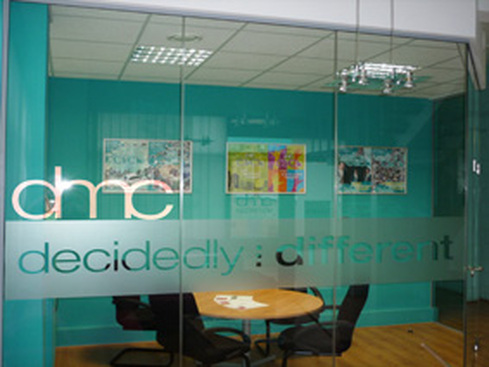
As it morphs into a service-led company with networked business machines DMC, gives its employees latitude to work from home and meet up in a ‘breakout room’ with this mural showing its “Decidedly Different” motto
To Kevin, upgrading digital connections to the fastest speed practicable is essential to this. “We are a company with a national sales and customer services operation,” he says. “Many colleagues work from home. We offer fibre to the home as a first choice for them and ADSL where this is not available. Smartphone use has also exploded as people stay in touch and execute tasks that used to be done on a desktop, when they are on the road. Staying connected with us here in Croydon is an essential prerequisite for us all to be able to deliver great service to the enterprises that use our products. Fast Internet is a proven productivity booster.”
As we visit DMC’s server room where Virgin’s external broadband cable terminates, you can see that Kevin takes his role seriously. I feel I am lucky to have made it this far in the building given his penchant for security. I am accompanied everywhere and Kevin required pre-visit references before I was even allowed over the threshold. Kevin’s caution also shows through in his view of DMC using The Cloud. “Not right us for us at present,” he asserts, “too expensive and we need reliability. I like to have my finger on the pulse.” I open my mouth to express the conventional thought that future use of The Cloud is inevitable for a business like DMC but think better of it. In any case, Kevin half-acknowledges this point when he states: “With the CVS broadband connection that we have now, which is upgradable to 100 mbps - we’re ready for it in any case. We can expand and grow as the business requirement dictates.”
Picture
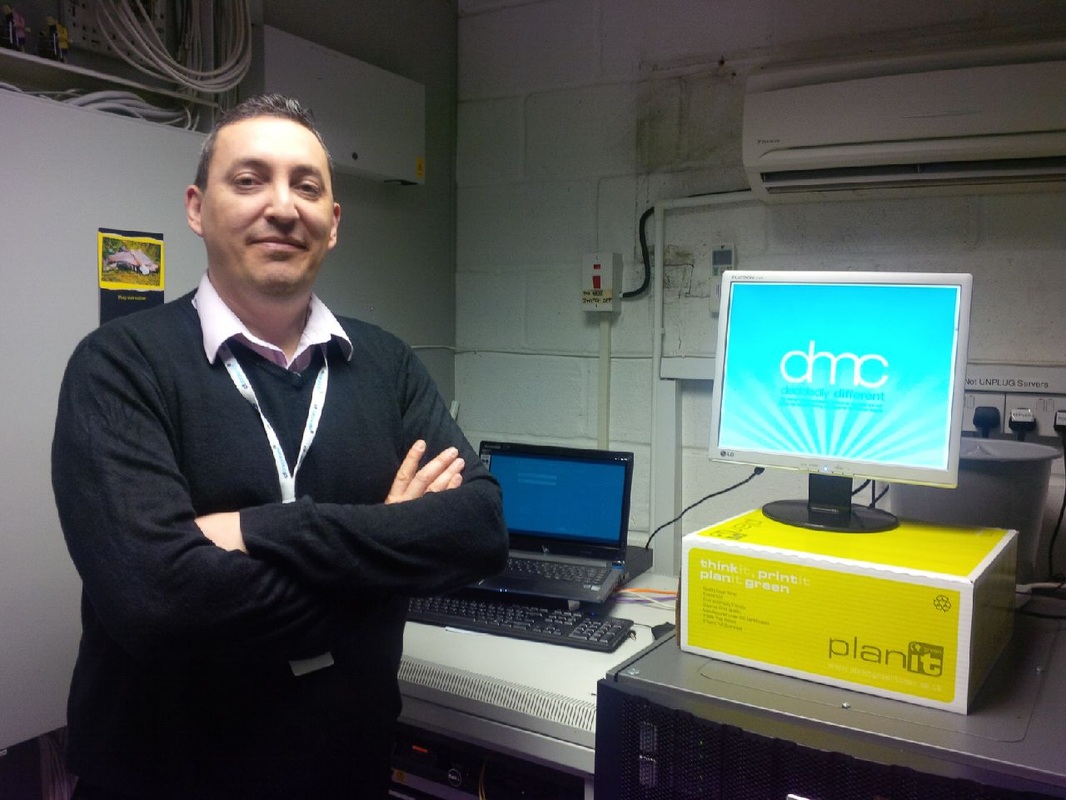
Connecting with Attitude. “Fast Internet is a proven productivity booster for DMC” says Kevin Streatfield.
In snapping a photo of Kevin in his lair, I ask about the ‘Planitgreen’ box on show. Kevin seems to grow an inch as he proudly explains: “That’s our branded toner solution. We sell 1000 toners a week now and it’s a business that’s growing fast, with a contribution from each sale going towards the Starlight foundation charity. We also collect and recycle all the cartridges completely free - all a customer has to do is login and arrange a time for collection. If they want to order more toner our fast lease connection means that they can do so instantly and the whole process is seamlessly booked into our integrated Sage accounting system. We will shortly open two web stores which will also use this same infrastructure.”

I ask Kevin about uptime and redundancy.  Unsurprisingly, he has the key data points on the tip of his tongue: “We were, at some busy periods, using 98% of the 10 meg line. On average we’re using 25-30% of the new pipe throughout the day so far but its early days. Still, I sleep better at night knowing we are not bumping up against a capacity ceiling at any time. Also we can plan to grow knowing that if the directors agree to acquire more companies we can accommodate new people, upgrade our service offerings and introduce new features. What’s more, we are at the cutting edge of the ‘Internet of Things’. The business machines we install on client premises increasingly tell us about whether they need a service, have a fault or simply need some new toner. The DMC Mother ship needed more bandwidth in order cope with the smarter business machines on client premises.”

More surprisingly, when I ask about usage, Kevin says, “It’s all about uploads for us. The marketing guys might view videos on line and upload ours to YouTube but mostly it’s about our engineers, sales people and customer service reps uploading data to our enterprise systems. Having a symmetrical connection makes all the difference rather than an old ADSL one.”

In terms of getting the connection Kevin says that the Voucher was essential. “The £3,000 voucher made the investment case much easier for the directors to sign off. I don’t think we would have upgraded without it. Everyone can now see the real benefits of a fibre connection. Virgin had to bring fibre at least 500 meters from the main road to our location and amazingly we are the only ones using it at the moment on the Purley Way. Virgin Media Business was very good throughout – first class – which, frankly, was essential given the importance of the Internet, at whatever speed, to our business. We’re set for growth and I have a lot of happy Users!”

All of which must be music to the ears of the DCMS Mandarin and his colleagues at the Greater London authority and Broadband Delivery UK (BDUK) who are administering the CVS Scheme in Croydon. It’s not always the case that a dream becomes a faster reality!
1 Comment

How The Power of Social Trading Platforms Will Transform Markets

25/4/2014

0 Comments

 
PictureWho Can Tame the Social Data Fire Hose?
It has been an unusually disruptive year so far for the financial trading industry. From novel revelations about the pip-rigging high frequency trading ‘Flash Boys’, through the annuities bombshell in the UK budget, to the recently reported ‘panic’ in the fund management industry over Facebook and Google’s emerging data mining power to offer innovative financial products, the hits just keep on coming.
 
As Too Big To Fail banks cut their proprietary trading teams, another slow burn disruptive force in 2014 for financial traders might well be the launch of Saxo Markets social trading platform TradingFloor.com. This electronic information bazaar aims to “set free the peer-to-peer power of traders around the globe by enabling them to connect online with experienced and like-minded investors who are tired of input from salespeople from traditional banks.” When coupled with the strength of technically driven instant trading alerts that make sense of the content that gushes from the social data fire hose (Twitter, Instagram, Blogs, Facebook, LinkedIn), social trading platforms will democratise financial trading.
 
If, according to Flash Boys author, Michael Lewis, boxes, lines and logic are the key elements of a successful HFT strategy, a natural language programme configurator, actionable content and community platforms that offer real time human intelligence that give context for open source trading signals are the technology equivalents for successful and profitable social trading platforms.
 
In fact, the quest to build the ultimate NLP configurator which generates actionable open source trading signals has been on for some time and until now was a relatively expensive proposition. As early as 2006, Monitor110 made the front page of the Financial Times as “an aggregator and filter for hedge funds trying to keep up with the explosion of information sources on the Internet.” Back then, this configurator was mainly aimed at making sense of blog posts since Twitter and other social media platforms were nascent at that time.
 
Now however, open source configurator development has gone mainstream, costs have fallen and core functionality can be licensed with everyone from enterprise software companies (SAP and IBM) and the giants of the business information industry (Bloomberg, Reuters, DnB) seeking to give client subscribers a trading edge through technology that makes sense of massive amounts of social data. The recent decision by struggling IBM to open up its game-show-Jeopardy-and-Garry-Kasparov beating Watson configurator to third party developers is potentially transformative for any social trading platform looking to grow its community by providing quality, real time, open source trading alerts. In short, the technology widely available today is now less a barrier to entry to social trading platform provision than the content analysis delivered by the brain power of the platform’s numerous community participants.
 
Naturally, the value of any configurator technology is judged by the quality of the data points that it returns. The world’s biggest hedge fund Bridgewater has been using "everything that is available" online, from social media to real-time Internet prices, to model economic activity in what is effectively real-time. Example of content of interest to Bridgewater includes tweets mentioning the purchase of new vehicles which can be used to estimate, calibrate and lead announcements of car manufacturers’ official figures. In commodities, aggregating social comments from farmers on the ground may also deliver tradable properties in Futures. What used to be gathered and assessed by highly paid travelling analyst teams of fund managers can be teed up for assessment by the crowd sharing thinking of a social trading platform.
 
Eventually, it this wisdom of the self-selecting crowds that use the most attractive of these platforms which will be seen as providing the missing operational piece for monetising open source trading alerts. This is, real time collective human intelligence that give these data points context. This does not mean that social trading platforms will level the playing field but that they will provide more open access to information. Market participants can then either directly trade signals as they arrive if they are confident that they confirm aspects of their own world view, thereby front running other traders who need further confirmation of what they are seeing from the crowd before they take a position. No matter what the risk appetite of individual traders, the powers of emerging social trading platforms to make sense of information flows will transform global markets.

Are You working on a project in this space? Contact me here, I can add value.

Like this? See: The 'InfoWorker Bullseye'

0 Comments
<<Previous
    Check the 'Categories List' below to select by topic.
    These Blog comments focus on developments in the Digital space. To discover how the
    ebbs and flows of markets, politics,
    conflicts, countries, people and money
    make the world go round see
    'Ballsy Thinking'.
    Picture

    Digital Ballsy Thinking
    (Pron. "bawl-zee thing-king")

    defined:
    adj: 1. Slang courageous and spirited reasoning; judgement  2. Characterized by clear, straightforward thought or thoughtfulness; 
    rational: “That’s the sort of Ballsy Thinking to move us towards our objective”.

    n.  1. The act or practice of one that thinks differently, innovatively; new thought.  2. Leading by way of reasoning; judgment: “This is not ballsy thinking, it is too timid an idea.”

    Picture

    Archives

    November 2018
    September 2017
    July 2016
    June 2016
    October 2014
    August 2014
    June 2014
    May 2014
    April 2014
    March 2014
    December 2013
    September 2013
    June 2013
    May 2013
    January 2013
    November 2012

    Categories

    All
    Artifical Intelligence
    Big Data
    Blackberry
    Business Information
    Client Case Studies
    Data Centres
    Digital Business
    Ecommerce
    Ethics
    Government
    Human Life
    Innovation
    Revolut
    Social Trading
    Tech City Movements
    The Cloud
    Uk Digital Strategy
    User Behaviour
    Wikileaks
    Windows 10

    RSS Feed

Picture
Current Status: 
Gary welcomes the opportunity to discuss projects that he might be able to work on with you.  
Tel: +44 7706 666 106 
 
Email: [email protected]
Picture
Photos from hans s, mikebaird