 Ethics is once again taking a shot to the head
 Tues 9July2013 Well as far as business information providers go, it's 'Here We Go Again!'
After the 'Bloomberg Breach' we have the 'Reuters Reach'!
Today's lead story in the FT reports that Thomson Reuters is under investigation for the practice of 'early releasing' the results of the Thomson Reuters/University of Michigan Surveys of Consumers, produced twice a month under an arrangement in which the company pays the university more than $1m a year. Apprarently, this survey has long been available to subscribers to its data terminals five minutes before the wider market sees the press release.
In their race to 'Reach' for profits, Thomson Reuters have created an ethical dillema for the business information industry worse than the Bloomberg Breach (see below). The only excuse for the management of Reuters is that its director team have been watching the movie 'Dumb and Dumber' rather than the 1980s classic 'Trading Places'. For if they had been watching the latter they would have remembered that the information that they sell is: MARKET SENSITIVE STUPID!
By paying money to a respected institution like the University of Michigan to deliver these surveys and then selling preferred access to the data is right up there in terms of unethical behaviour. Just as in the movie Trading Places where the protagonists sought to get a jump on the market for orange futures by knowing production yields, so high frequency traders try to make profits by wringing nano second advantages out of their information sources. At best this can be justified as these traders having better technology prowess but Reuters just added to their unfair positions relative to home or day traders in the markets.
It is right that the actions of Thomson Reuters should be condemned. However, the actions of this firm have been so brazen that they may also result in new government regulations that further distort the market for business information for everyone and raise barriers to entry for new entrants into this market.
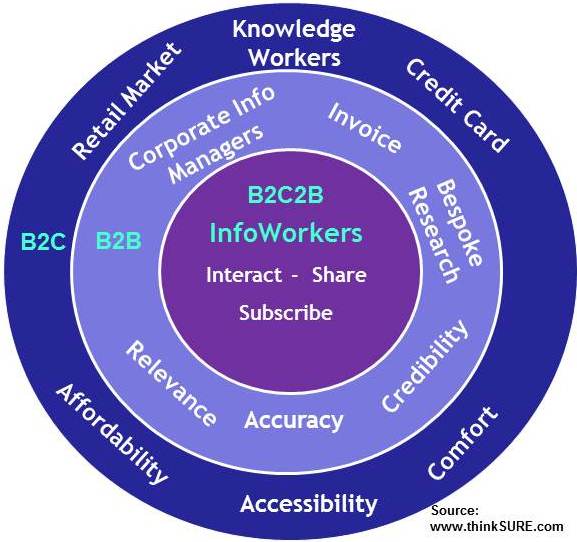
Into Business Information? Check Out the: The 'Infoworker Bullseye' - Simple Segmentation of the 'Paid For' Online Global Business Information Space.
After the 'Bloomberg Breach' we have the 'Reuters Reach'!
Today's lead story in the FT reports that Thomson Reuters is under investigation for the practice of 'early releasing' the results of the Thomson Reuters/University of Michigan Surveys of Consumers, produced twice a month under an arrangement in which the company pays the university more than $1m a year. Apprarently, this survey has long been available to subscribers to its data terminals five minutes before the wider market sees the press release.
In their race to 'Reach' for profits, Thomson Reuters have created an ethical dillema for the business information industry worse than the Bloomberg Breach (see below). The only excuse for the management of Reuters is that its director team have been watching the movie 'Dumb and Dumber' rather than the 1980s classic 'Trading Places'. For if they had been watching the latter they would have remembered that the information that they sell is: MARKET SENSITIVE STUPID!
By paying money to a respected institution like the University of Michigan to deliver these surveys and then selling preferred access to the data is right up there in terms of unethical behaviour. Just as in the movie Trading Places where the protagonists sought to get a jump on the market for orange futures by knowing production yields, so high frequency traders try to make profits by wringing nano second advantages out of their information sources. At best this can be justified as these traders having better technology prowess but Reuters just added to their unfair positions relative to home or day traders in the markets.
It is right that the actions of Thomson Reuters should be condemned. However, the actions of this firm have been so brazen that they may also result in new government regulations that further distort the market for business information for everyone and raise barriers to entry for new entrants into this market.
Into Business Information? Check Out the: The 'Infoworker Bullseye' - Simple Segmentation of the 'Paid For' Online Global Business Information Space.
What Can Other Business Information Providers Learn From the 'Bloomberg Breach'? To Secure Usage Data Too...
14May2013 What an adrenalin fuelled weekend for Big Data and Business Information junkies! Four quite separate episodes that highlight why digital information is such a powerful weapon susceptible to misuse in modern economies, business and life.
First, the US Internal Revenue Service admits that it used its powers to demand information to 'unfairly' target Conservative Groups such as the Tea Party. (See here)
Second, one of the most incredible cybercrime global bank heists of all time was perpetrated against Middle East Banks. (A must read here)
Third, the G7 affirmed at their meeting in Alyesbury (of all places!) to step up their ground breaking information sharing agreement on offshore tax havens after a massive data leak from these places exposed dark financial secrets. (See Here)
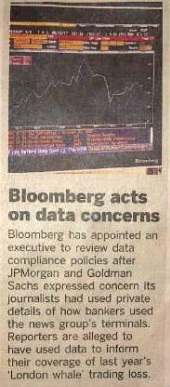
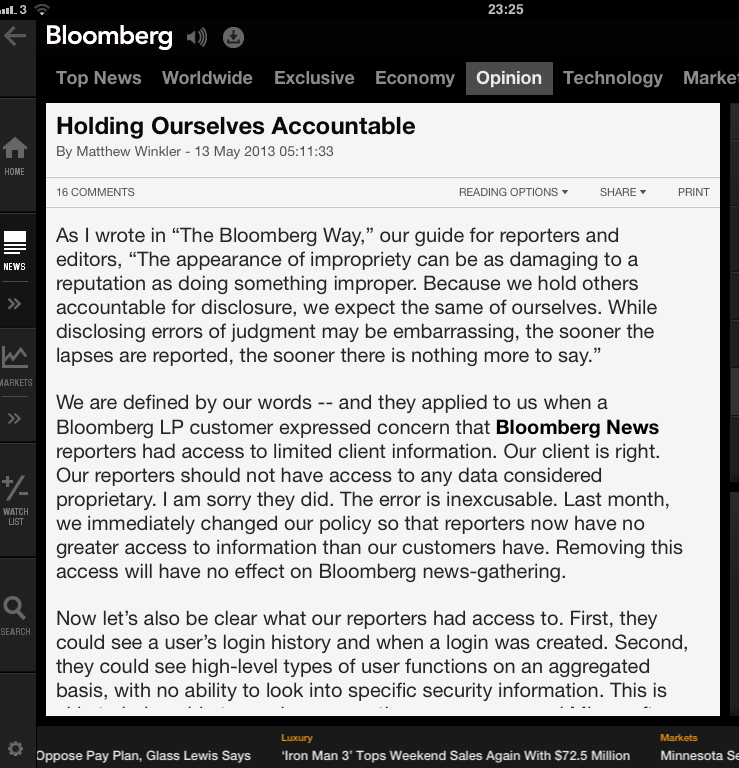
Fourth, business data provider Bloomberg may face an investigation by the Feds after it admits that its news reporters had access to sensitive information about customers' activities on Bloomberg financial data terminals, such as subscribers' contact information and login activity, all of which was used to advance reporting. On Monday, editor-in-chief Matthew Winkler apologised for allowing journalists to use the usage statistics, calling it "inexcusable" and that customer data was protected.
Arguably this last episode is most shocking given the fact integrity and credibility are two essential elements for any Business Information Provider like Bloomberg. That the political appointees at the IRS might want to advance their patron's cause (with or without their knowledge) is hardly surprising if you understand politics inside the Beltway. That criminals should be smarter than the banks and their (in this case) Indian outsourced IT suppliers has been proven time and time again. While the fact that the G7 are now taking measures against offshore tax havens, many of which are within their arms-length jurisdictions, is inevitable given domestic political and economic pressures. However, it is clear that while Bloomberg makes a great effort to protect its core data sets, it seems it does not take as great a care with its customer usage statistics.
First, the US Internal Revenue Service admits that it used its powers to demand information to 'unfairly' target Conservative Groups such as the Tea Party. (See here)
Second, one of the most incredible cybercrime global bank heists of all time was perpetrated against Middle East Banks. (A must read here)
Third, the G7 affirmed at their meeting in Alyesbury (of all places!) to step up their ground breaking information sharing agreement on offshore tax havens after a massive data leak from these places exposed dark financial secrets. (See Here)
Fourth, business data provider Bloomberg may face an investigation by the Feds after it admits that its news reporters had access to sensitive information about customers' activities on Bloomberg financial data terminals, such as subscribers' contact information and login activity, all of which was used to advance reporting. On Monday, editor-in-chief Matthew Winkler apologised for allowing journalists to use the usage statistics, calling it "inexcusable" and that customer data was protected.
Arguably this last episode is most shocking given the fact integrity and credibility are two essential elements for any Business Information Provider like Bloomberg. That the political appointees at the IRS might want to advance their patron's cause (with or without their knowledge) is hardly surprising if you understand politics inside the Beltway. That criminals should be smarter than the banks and their (in this case) Indian outsourced IT suppliers has been proven time and time again. While the fact that the G7 are now taking measures against offshore tax havens, many of which are within their arms-length jurisdictions, is inevitable given domestic political and economic pressures. However, it is clear that while Bloomberg makes a great effort to protect its core data sets, it seems it does not take as great a care with its customer usage statistics.
For other Business Information Providers this is a wake up call for they are already under the microscope as a result of two seemingly unstoppable mega-trends affecting their industry: Cloud Computing and Big Data. Increasingly the offerings of Business Information Providers trumpet their expertise in these areas. (DnB, Experian, Equifax)
Any CIO of a large corporate customer of these firms making a pitch to their own Board about moving sensitive corporate data from on-premise servers to the Cloud will be faced with questions about security. Similarly, privacy concerns are at the heart of both government and marketers attempts to leverage value from Big Data projects.
As a recent article in Foreign Policy says: "Big Data helps answer what, not why, and often that's good enough...The Internet has reshaped how humanity communicates. Big Data is different: it marks a transformation in how society processes information." (My italics)
In this context, if there is a lesson from the 'Bloomberg Breach' for Business Information Providers it is that customer usage patterns and how customers process their information, are just as valuable a commodity in modern data analysis as mining the raw data itself. As a result these data usage sets need to be covered by security policies too.
Of course, in many cases such patterns will be protected by the privacy rules governing access to customer accounts but these may well need reviewing in light of the ways in which patterns can be deemed enough to determine what course a company is pursuing even if the patterns alone cannot answer why.
The increasingly sophisticated risk products on offer from global business information providers mean that patterns can be discerned even if key client data is protected. A customer service representative who can view a customers' credit information portfolio can gain useful insights into which markets that client is targeting and getting business. A list of industry or market research reports that a client company is purchasing may be a tell as to future business or acquisition strategies. These are simple examples and not those where a Business Information Providers' people can view Big Data outcomes connected to spatial or cluster analysis. It would be interesting to see how much access to the queries that customer service and marketing people have in these instances.
The bottom line is, that customer service representatives may not be as inquisitive or knowledgeable as Bloomberg journalists. But as last weekend's Middle East Bank heist shows, there are always external nefarious people out there who are looking to tap and trap the less knowledgeable in order to connect the Dots!
Into Business Information? Check Out the: The 'Infoworker Bullseye' - Simple Segmentation of the 'Paid For' Online Global Business Information Space.
Any CIO of a large corporate customer of these firms making a pitch to their own Board about moving sensitive corporate data from on-premise servers to the Cloud will be faced with questions about security. Similarly, privacy concerns are at the heart of both government and marketers attempts to leverage value from Big Data projects.
As a recent article in Foreign Policy says: "Big Data helps answer what, not why, and often that's good enough...The Internet has reshaped how humanity communicates. Big Data is different: it marks a transformation in how society processes information." (My italics)
In this context, if there is a lesson from the 'Bloomberg Breach' for Business Information Providers it is that customer usage patterns and how customers process their information, are just as valuable a commodity in modern data analysis as mining the raw data itself. As a result these data usage sets need to be covered by security policies too.
Of course, in many cases such patterns will be protected by the privacy rules governing access to customer accounts but these may well need reviewing in light of the ways in which patterns can be deemed enough to determine what course a company is pursuing even if the patterns alone cannot answer why.
The increasingly sophisticated risk products on offer from global business information providers mean that patterns can be discerned even if key client data is protected. A customer service representative who can view a customers' credit information portfolio can gain useful insights into which markets that client is targeting and getting business. A list of industry or market research reports that a client company is purchasing may be a tell as to future business or acquisition strategies. These are simple examples and not those where a Business Information Providers' people can view Big Data outcomes connected to spatial or cluster analysis. It would be interesting to see how much access to the queries that customer service and marketing people have in these instances.
The bottom line is, that customer service representatives may not be as inquisitive or knowledgeable as Bloomberg journalists. But as last weekend's Middle East Bank heist shows, there are always external nefarious people out there who are looking to tap and trap the less knowledgeable in order to connect the Dots!
Into Business Information? Check Out the: The 'Infoworker Bullseye' - Simple Segmentation of the 'Paid For' Online Global Business Information Space.


 RSS Feed